
when the campus was young
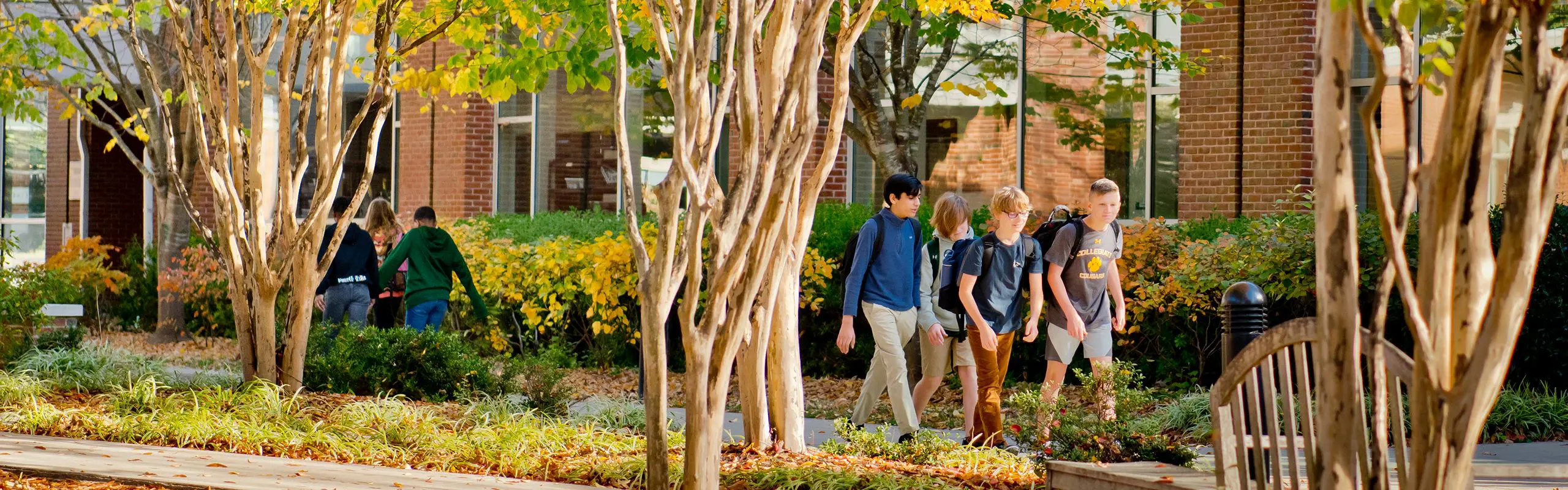
Imagine for a moment a simpler time when there were more trees than students on Collegiate’s North Mooreland Road campus.
Imagine a time when Catharine Flippen, Elizabeth Burke, Mac Pitt, and Petey Jacobs were guiding the school in the direction of greatness with, by today’s standards, a minimum of tangible resources.
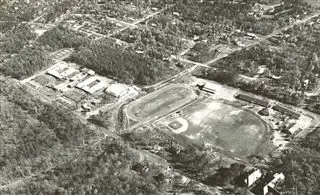
Imagine no turf fields, no athletic center, no computers, no air conditioning, no Smoothie King at lunch each Thursday, no loop road.
Ah, yes.
The loop road.
In mid-January after much planning and fanfare, the loop road and adjoining two-acre parking lot opened for business on the east side of campus.
They’re part of an ambitious capital project that will ultimately include a classroom building and state-of-the-art academic commons as well as renovations and additions to existing facilities, some of which date back to the Eisenhower administration.
The new road provides one-way entry and egress and offers a drop-off/pickup area almost a quarter-mile long.
The plan was to provide safe and efficient access and alleviate the congestion along North Mooreland, but there have definitely been some bugs.
While folks quickly learned the routine and the morning traffic flow along the new thoroughfare has become, for the most part, smooth, the entire situation remains under study.
This column isn’t about traffic, however.
It’s about the evolution of the eastern stretch of campus from the dark ages until progress brought it to its current state.
Back in the ‘60’s, that tract of land was completely wooded.
Neighborhood kids used it as their personal playground, building forts and campfires, riding their Sting Rays through the trails, and perhaps engaging in a few other activities upon which the adults in their lives might have frowned.
They played in the creek and caught crayfish, tadpoles, and an occasional snake.
In those days, a small science building was the eastern-most structure on campus. It was located directly behind the present-day Reed-Gumenick Library and provided a staging ground for a host of nature studies in the adjoining sylvan expanse.
Middle School boys hung out in the woods during recess and used the trails as a short cut to their phys ed classes in the West Gym.
No one gave safety a second thought.
As enrollment and program offerings expanded, the only alternative was to bulldoze the stately oaks and pines.
Those who were around in the ‘70’s remember well the hard-scrabble field that emerged next to the gym.
In the fall, football teams used it for practice.
In the winter, the boys’ soccer team bundled up and played on the frozen tundra.
In the spring, it became a baseball (and later softball) diamond with no backstop and home plate in the corner where the footbridge to Sleepy Hollow now stands.
Folks who dared park close by did so at their own risk.
The tennis courts were located behind the present-day Hershey Center.
While they were used mostly for their intended purpose, two other memories endure.
In the early ‘80’s, a student group organized a Bruce Olsen and the Offenders concert. Suffice it to say that the noise and accompanying merriment were not well received by everyone within earshot.
On April Fool’s Day several years later, two classes of 7th grade boys left lunch early, moved all the desks and chairs from Rooms 1 and 2 to the far reaches of the courts, and arranged them just as they had been inside.
They thought, of course, that they were pulling the ultimate prank on their unsuspecting teachers (Charlie Blair and me) who would arrive to empty classrooms.
It was a beautiful spring day, perfect for an outdoor experience, so we taught our lessons as planned, then helped the guys return the furniture to its original location.
During the 80’s, the field adjacent to Jacobs Gym gave way to the athletic center and tennis courts, the fine arts building rose from a former parking lot, and more trees were cleared to create a soccer field along Tarrytown.
During the next decade, a state-of-the-art science complex and well-coiffed softball and hockey facilities replaced the open spaces behind the classroom buildings.
Many unforgettable athletic contests played out on that parcel that’s now asphalt, concrete, and landscaping.
Two come quickly to mind.
One afternoon in 1998 amidst the spectacular fall foliage, the Cougars won the first-ever VISAA field hockey title with a thrilling 5-4 overtime win over Norfolk Academy.
In the spring of 2000, the Cougars softball team trailed St. Gertrude 3-0 in the final inning of the championship game of the League of Independent Schools tournament.
Though down to its final out, Coach John Moreau’s squad stunned the Gators with an inspiring, against-all-odds rally to claim a 4-3 victory.
The fields and tennis courts are gone now, relocated a couple of years ago to the Robins Campus.
The playgrounds are gone as well.
The wallball games outside Hugh Addy’s classroom, the stickball marathons, full-court pickup basketball at recess, lacrosse balls banging against the back walls of the science buildings…all are memories.
What’s really gone are the simple days.
“Blue sky time” for kids seems so fleeting.
Collegiate – and the world, for that matter – moves at breakneck speed, and the jumble of vehicles entering and exiting our campus at rush hour seems a perfect metaphor for the craziness of life.