
visiting collegiate's past, part two
When last we visited with Alex Smith, we were standing in McFall Hall, the latest stop on our tour of noteworthy yet often overlooked sites around Collegiate’s North Mooreland Road campus.
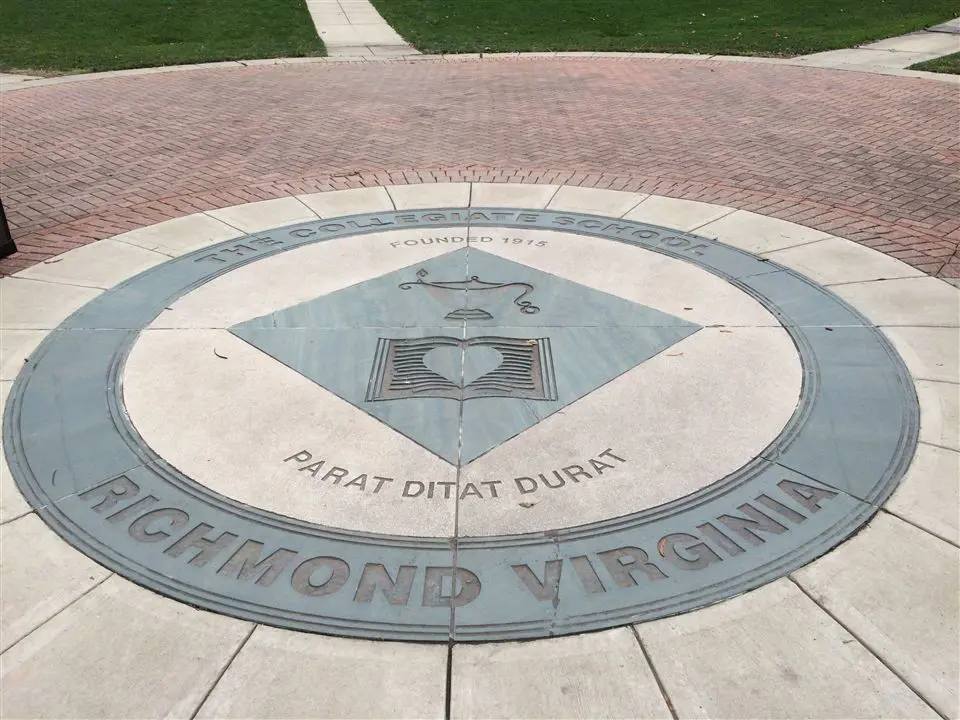
After exiting the building once known as Memorial Hall, we walked across the lawn in front of Flippen Hall to check out the Great Seal embedded in the walkway at the opening between sections of the low, aesthetically pleasing brick wall that runs north-south along the frontage of the campus.
Until 1990 when masons constructed the wall, the property actually “bled” right into the curb. There was no definition, no buffer, no gateway, just your basic, concrete sidewalk.
The Seal, which is 12 feet in diameter, provided the perfect touch.
“It was a really neat embellishment because we were looking for some signature items that would signify the history of the school,” said Alex, a 1965 graduate who has worked at his alma mater for 46 years, mainly as vice-president for development and more recently in the area of major gifts.
“Up until this point, Collegiate didn’t have many cultural, artistic types of statuary or symbols. It was actually a rather plain campus.”
The Seal was made mostly from bluestone imported from the United Kingdom. It includes the school’s motto – Parat Ditat Durat – and symbols representing truth, wisdom, and knowledge.
Next time you’re out there, take a good look at the lamp. Compare it to other renderings of the Seal around the campus. Notice the loop just beneath the handle? Looks like a nice, decorative adornment. Right? Wrong. It’s not supposed to be there.
“That extra do-dad,” Alex said, “was actually a piece of trash that was on the fax machine, and the artist took it as part of the artwork. That exact same Seal is at the gateway between the brick walls at the Lower School, and there’s no extra do-dad on the lamp of learning.”
Our next stop was the walkway on the south side of the Development Office and Cougar Shop.
Embedded in the sidewalk there is a beautiful granite plaque honoring Mrs. Catharine Stauffer Flippen, who headed The Collegiate School for Girls from 1940 – 1959, facilitated school’s move west, and headed the Girls School from 1959 until her retirement in 1972.
It’s been around since 1955 and was originally located at the Lower School, which is the old Collegiate Country Day site. It was placed to express gratitude for those who played a role in the development of the Mooreland Road site.
“In 1997, when we started a massive construction project,” Alex said, “most of the original country day school was torn down because it wasn’t structurally worth saving.
“I had the plaque saved and put away. It actually sat for about 10 years under my office window because I didn’t want it to get broken. It ended up over here just because it fits in this courtyard very nicely.”
But there’s a slight problem. Written in stone – literally – is the misspelling of Mrs. Flippen’s first name: “Catherine” rather than “Catharine.”
“Some of the little idiosyncrasies that come with our history,” Alex added, “like the do-dad on the lamp of knowledge and Mrs. Flippen’s name being spelled wrong.”
What do these monuments represent to you? I asked Alex.
“A walk through history,” he replied. “The names on the doors and buildings and walkways remind us of people who’ve gone before and who’ve been leaders or generous in some way. We exist because of previous generations of generosity and visionary thinking.
“It’s nice for Collegiate to have that DNA running through it. There’s a lot of gratitude in my heart for the people who have come before.”