
training for excellence
They drift in one by one, the ailing, the injured, and those simply in need of a Band-Aid or bag filled with ice.
Soon, the training room in Collegiate’s athletic center is teeming with athletes of all ages, sizes, and levels of experience, each anxious to tend to business and move to the next endeavor.
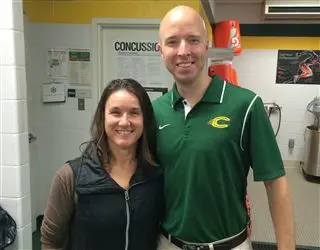
Amidst the organized chaos are Shannon Winston and Jason Engle.
Both are dedicated, knowledgeable, and skilled certified athletic trainers with undergraduate and master’s degrees in their specialty.
Both are great listeners and diagnosticians.
Both are patient to a fault and dedicated to serving the best interests of the young women and men entrusted to their care.
“I can empathize with the kids who are injured because I was an injured athlete on several occasions,” said Shannon, a soccer and softball player at Hermitage High and Radford University with surgical scars on both knees. “I really care about getting these kids back to their sports quickly and safely.
“I love being around sports, being around athletes. It’s satisfying to see kids get back into the sports they enjoy so much.”
Shannon, who arrived at Collegiate in the fall of 1998, never considered another career.
“When I tore my right ACL in high school, I was fortunate to have an athletic trainer (Barry Simon) to guide me through the year,” she said.
“That got me more involved with training because I was on the sidelines and couldn’t participate.”
Jason was a wrestler and football player at Lackawanna Trail High School in Factoryville, PA (where, he adds with a smile, there is actually no factory).
He observed the work of the trainer assigned to his sports and decided to pursue his passion, first at East Stroudsburg State, then at Indiana State.
“I always liked anatomy and biology classes,” he said. “To combine that with sports and getting injured athletes back to playing was really interesting.”
Jason joined Richmond Physical Therapy in 2006, spent afternoons at Collegiate, then came on board full-time in 2013.
During the winter season, he and Shannon oversee the training room on the main campus. In the fall and spring, he holds forth at Robins.
Much of their job is hectic, but much is routine and occurs well out of the spotlight.
“Ninety percent is preparation,” Shannon said. “We work on procedures, concussion management policies, emergency action plans, documentation.
“We do a lot of behind the scenes stuff with treatment, rehab, and evaluation.”
The other 10 percent occurs in the public arena, often in time-sensitive situations.
Case in point.
Several years ago, a Mills Godwin goalkeeper fell unconscious after a collision during a girls’ soccer match.
In a flash, Shannon, stationed on the sideline, was on the scene.
“Several girls went up for the ball at the same time and hit the ground,” she recalled. “The goalkeeper didn’t get up.
“The symptoms were pretty scary at first. Her face was getting pale. Her lips were becoming blue.
“When the ambulance got there, they spine-boarded her, neck-braced her, and sent her on her way.
“She had a concussion, but she ended up being OK.”
The profession has changed over the years.
“It’s much more research based now,” said Jason, who is also an accomplished marathoner and triathlete.
“When I started, we did this treatment or that treatment because we’d always done it and it had always worked.
“Now, the emphasis is on why the particular treatment works and the facts and data to back it up.”
He cites ACL surgery as an example.
“Fifteen or 20 years ago, you would be in a straight-leg cast for six weeks,” he said. “It would be really hard to get that motion back.
“Now, they try to get that knee moving as quickly as they can, protecting the graft, obviously. The research is showing that the sooner you can get the joint moving, the better the outcome.
“They’ll see a PT (physical therapist) for 4 or 5 or 6 weeks. Then, we can start to take that over as a transition from that office to a little more functional type activity.”
Shannon and Jason cover literally hundreds of practices and competitions each year.
Their hours are long, their commitment inspiring, their intangible rewards priceless.
“When you see kids go out and compete and do what they love doing,” Jason said, “that makes it all worthwhile.
“As much as I enjoy spending time with them, to see them perform is great.”
“Truly,” Shannon added, “it’s about making sure these kids get the proper care and education and information they need to get back into action.
“To see that happen is very satisfying.”