
the light shines brightly
There’s a light at the end of this long, dark tunnel, Jake McGee’s reminded himself over and over and over.
And I’ll get there. I’ll absolutely get there. And I’ll be better than ever. Promise.
Ready or not, like it or not, such was life for the 2010 Collegiate graduate for the better part of six months spanning this past fall and winter.
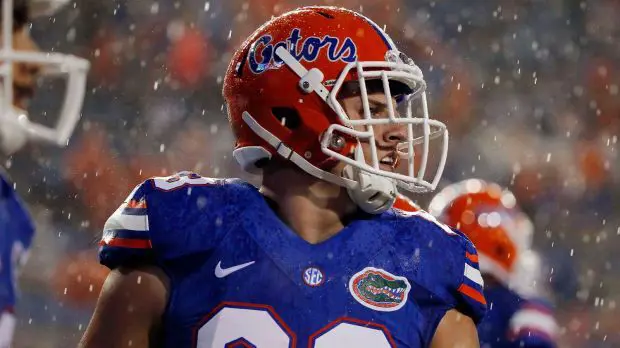
An ultra-successful, highly-decorated two-sport high school athlete, he’d moved on to the University of Virginia, played three years of football, and earned a B.S. in psychology before transferring to the University of Florida for his final season of eligibility.
He arrived in Gainesville in May 2014, quickly connected with his coaches and teammates, prospered during summer workouts and August training camp, and earned a starting spot at tight end. Then, early in the second period of the Gators’ first game with Eastern Michigan, he took a hit, fell awkwardly, and suffered a fracture of his left tibia and fibula that required surgery that very evening. What had seemed so perfect one moment became a challenge he could never have imagined the next.
“It was a freak injury,” McGee explained one afternoon recently. “It was something I wasn’t ready for. It was definitely a difficult time, but you have to respond to adversity. I embraced things and made the most of the situation.”
No question about it, a tib-fib fracture is significant game-changer. There’s no quick fix, no short cuts, no down days. The enormity of the task can break your spirit. Rehab is not for the faint of heart. Some who suffer the injury never return to full strength, even as recreational athletes. Others have limited success. Recovering well enough to play football in the Southeastern Conferences requires a grueling regimen of physical therapy over an extended period of time that can test even the toughest person’s patience, resolve, and mettle.
McGee, predictably, was undaunted. He remained steadfast. He attacked his challenges with passion, discipline, and singleness of purpose. He allowed himself no other option.
His home away from home became the UF training facility. Seven days a week, he reported at 7 a.m. and worked straight through until late afternoon with breaks only for lunch and graduate classes in sports management.
“I’ve been playing football my whole life,” McGee said, “but this was definitely harder. At the beginning, you get the worst-case and best-case scenarios. I had a lot of confidence in myself. I knew that if I did what I was supposed to do, I’d be back. Injuries happen. You can’t let the highs take you too high or the lows get you too low. Even though it was a bad situation, I couldn’t let it affect my attitude, or it would bring everything down.”
The NCAA granted him a sixth year of eligibility, and McGee has flourished in his final season.
First-year head coach Jim McIlwain and offensive coordinator Doug Nussmeier brought a tight end friendly philosophy, and McGee, at 6-6, 250 and 24 years old, has become a fearsome blocker whose stat line reads 23 receptions for 200 yards and three touchdowns, two of which came in the first half in a 35-28 loss at LSU.
The Gators are 6-1 and ranked 13th in the Associated Press Top 25. Among their SportsCenter moments are a 28-27 victory over Tennessee after they trailed by 13 with four minutes remaining and a 38-10 blowout of No. 3 Mississippi a week after the Rebels defeated Alabama.
“We’re trying to put the best product we can on the field,” McGee said. “The confidence level is high. Guys are all bought in.”
This is a bye-week for the Gators. Next up, are games with Georgia, Vanderbilt, Florida Atlantic, and Florida State. With six victories, they’re already bowl-eligible.
The future is bright. He’ll be two credits short of his graduate degree after this semester and vows to finish in the spring. And he hopes to hear his name called in the National Football League draft in late April.
“From everything I’ve heard,” he said, “I have a very good shot to keep going. I’m in a good position to fulfill my dream, but I want to enjoy this (Florida experience) as much as I can before (football) turns into a profession. At Collegiate, I always saw myself playing sports at the next level, but I don’t know if I saw it ending up like this. It’s gone as well as I could have imagined. It’s been a long road with some bumps, but I wouldn’t trade it for the world.”