

the destiny of her soul
Granny knows best.
Ask folks who grew up in Bernice, Louisiana, from the ‘60’s until she passed away in 2001, and they’ll vouch for the fact that – yes, indeed – Granny does – present tense – know best.
Granny, whose real name is Rosetta Malone, was a hard-working, kind-hearted friend to all, a one-of-a-kind icon who dispensed wisdom and insight and encouraged those around her to reach for the stars.
Her influence permeated the small, rural town near the Arkansas line. Pretty much everyone, relative or not, called her Granny and drew inspiration from her example and counsel.
None more so than Tammy Dunn.
You see, to most, Granny was the town matriarch. To Tammy, Granny was her larger-than-life, flesh-and-blood maternal grandmother.
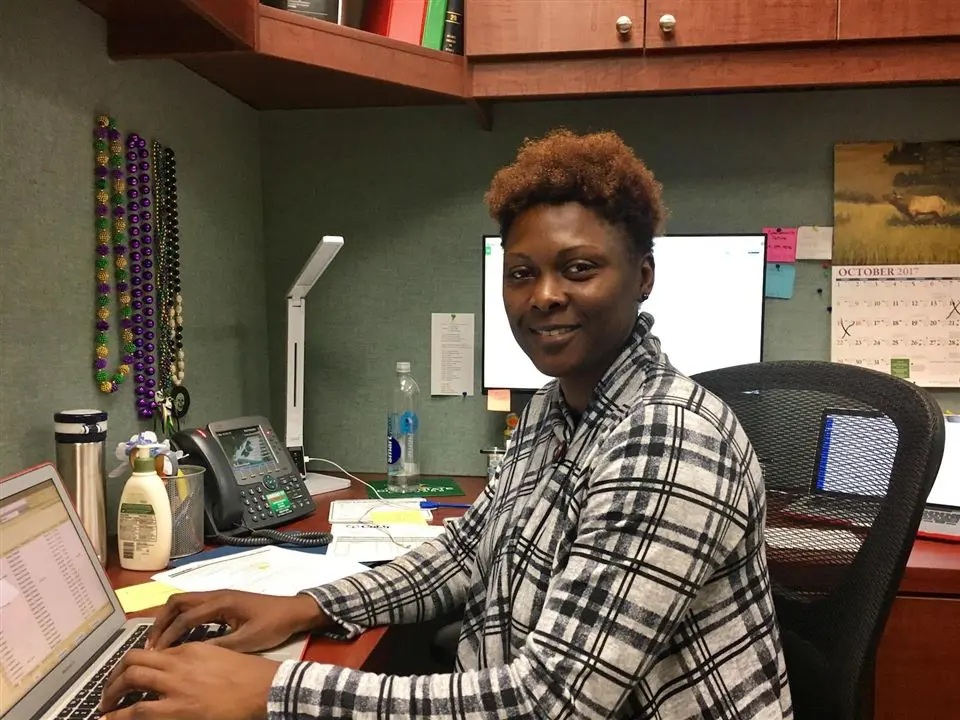
“Granny always told me, ‘No matter what people say, you can be what you want to be,’” said Tammy, since 2016 the administrative assistant in Collegiate’s technology department. “She thought I could be somebody. She always said, ‘You are the destiny of your soul.’
Sage advice, to be sure. It resonated with Tammy when she first heard it. It’s resonated with her ever since.
“My grandmother was really involved in my life,” she said. “My mom (Peggie Thompson) worked. I was a latchkey kid. She trusted me. She taught me to be independent. I learned to be strong from my mom. I learned wisdom from my grandmother.”
When Tammy was 18 and fresh out of high school, she enlisted in the U.S. Navy, a leap of faith for a young woman who had never ventured very far from her small hometown. Then, in November 1990, she boarded a plane at Shreveport Regional Airport an hour away and headed to the Naval Training Center Orlando to begin the adventure of a lifetime.
“When I got to boot camp, I had no idea who people were or what was going on,” she said. “I’d never seen a place like that before. All women, in barracks, trying to get situated. I knew if I could get through boot camp, the world would be mine. Quitting was never an option.”
She survived, of course, and eventually landed at her first duty station at NAS Whidbey Island in Washington State, where, as an oceans systems technician with top-secret clearance, she tracked submarines, both “threat” and “non-threat.”
By this time, the culture shock had worn off. The country girl from Bernice was all-in.
“A chief (petty officer) told me, ‘If you stay the way you are, there’s nothing you can’t be in this Navy,’” she recalled. “I kept that in mind.
This was a white female chief. I say that to make a point. I was the only black female on that post. She always made it a point to see that I was okay.”
There were times, though, that Tammy wasn’t okay. There were instances when she felt bias directed at her – either unwittingly or intentionally – because of her race and gender.
“That didn’t stop me from moving forward,” she added, “but sometimes I had to rethink. Trust but verify. Trust but know. Trust but be cautious.
“Every time I’d go into a meeting, I was always the only black female. I wouldn’t say much. My boss told me, ‘If you want to be heard, speak up. If you want to be seen, stand up. If you want to be appreciated, know when to show up.’ That didn’t change me being the only African-American female. It did change how others saw me.”
Tammy’s next stop was a base in Brawdy, Wales, where she continued to track subs, this time in conjunction with the Royal Navy.
“That was fun,” she said, “but I wanted something different.”
Her commanding officer needed a secretary, and Tammy landed the job because she was meticulous, detail-oriented, diligent, and “by the book.”
Then…
“It was going OK,” she said, “but one day he came up to my desk and said, ‘You are a horrible secretary.’ I can still hear those words. I looked at him. I didn’t know what to say. He just walked back into his office. I thought, OK, Wow! I’m really screwing up. And the guy himself told me.
“I asked my chief, ‘What am I supposed to do? Here I am, an E-4, and he told me I’m horrible.’ She said, ‘Think about it and come back.’
That’s when I heard my grandmother’s voice in my head: You are the destiny of your soul.
“I said to myself, ‘I’m not going to quit. He’ll have to fire me.’ So I went to his office, knocked on his door, and said, ‘Sir, I understand why you said I’m a horrible secretary because I am. But if you give me another chance, I will turn this around.’ He said, ‘You have the rest of the week.’”
Given a brief reprieve, Tammy launched into her duties with zeal and determination. She was all business, all focus. Still, she wondered.
“That Monday morning,” she continued, “he came to my desk. He said, ‘I’ve never seen anyone turn around like that. If you continue this, you’ll be my secretary the whole three years I’m here. And I’ll write a letter saying where you’re going next…wherever you want to go. He did that.”
Her choice was her first ship: the USNS Saturn based in Norfolk. By then, she had completed training to become a data processor, a position now called information technology specialist. Her primary responsibility would be ensuring efficient communication among ships.
Through adversity, she had stayed the course. She had proven herself to doubters. Once chastised, she beamed as her commanding officer, once a naysayer, publicly praised her ability, dedication, persistence, and pluck. She was en route to a long, fulfilling career that would provide a wealth of experience and a healthy perspective in a rapidly changing world.
“People always want to know, Were you on any ships? Did you go around the world? Did you shoot anybody?” she said. “The job is the job no matter where you go. The story is the people. In the military, you have to rely on each other. It wasn’t optional. There’s no day off. It’s around the clock.”
With each accomplishment came opportunities with greater responsibility.
“One of the highlights on the Saturn was being in charge of higher ranking personnel at a very young age,” she said. “I had to make sure communications was there ship to ship and in house. Everything was done the right way. I was the one on-call in the middle of the night. I supported everybody. Everybody supported me. Once again, I was the only black female in an all-male shop. Life wasn’t always easy, but I did what I had to do.”
What she considers her career highlight came when she served as lead communicator on the USS Mason, a destroyer once manned by an all-African American crew and cited for “selfless bravery” during World War II.
“Best ship I’ve ever been on,” she said. “The crew was amazing. We had all races. It shows how far we’ve come. We showed that if we all work together we could do anything we had to do.”
After her tour on the Mason ended, she went to the Stennis Space Center near Bay St. Louis, MS, where, as the only female and now an E-6 (petty officer first class), she trained with the elite Special Boat Team 22.
“This was when I went to Iraq for the first time,” she said. “My boss came to me one morning and told me, ‘You’re being deployed with the SBT-22 and the SEALS.’ I just froze. I hadn’t done all the SEAL training, but I was prepared. I wasn’t scared, but my mother was. I told her that was what I signed up for.”
Her assignment was to facilitate communication for the “boots on the ground.” What an education she received! The images she had seen only on television came to life.
“You’re watching people pushing buttons and blowing things up,” she said. “It looks like a video game, but it’s real. My job was to communicate with my team, the Army, and the Marines down the road. It was an eye-opener. You have to be strong. You have to be numb to everything and keep moving.”
In 2008, Tammy earned promotion to E-7 (chief petty officer) and began work as a substance abuse counselor, first in Gulfport, MS, then in Japan.
“Greatest job in the world,” she said. “I saved the lives of military members from a substance that was readily available to them: alcohol. I was determined to save every one. Lost just one. Committed suicide. That was tough. You grow up fast.”
In 2014, when her daughter Jazie was five, Tammy retired.
“Overall, my career was exciting, challenging, never a dull moment, even though there were some bad moments,” she said. “There’re difficulties in everything, but we did bleed Navy Blue. At the end of the day, we took care of each other. I wouldn’t trade one single day.”
Michael Talbert, a friend, mentor, and big-brother figure from her Navy days, suggested a move to Richmond where he lived.
She researched schools long distance from Japan. Collegiate proved just the right fit. In August 2014, Jazie started kindergarten, and Tammy landed a job in Cougar Quest. When the tech office post opened, she jumped at the chance to answer the call and accept yet another challenge.
“I was raised to believe in myself,” she said. “My grandmother taught me that if you want something badly enough, you’ll find a way to make it happen. Do your best. Don’t quit.”
Still the voice?
“Still the voice,” she responded with a smile. “Always.”