
serving with excellence
The next time you log on to Collegiate’s computer network, offer a word of thanks, please, to a guy named Dave Sherman.
Who is Dave Sherman? you ask. Chances are you’ve seen him hustling purposefully about the campus, fixing this, shoring up that, and doing it all quietly and without fanfare.
Beneath-the-radar suits him fine.
Sherman, you see, is humble, soft-spoken, unpretentious, and 100 percent dedicated to serving Collegiate with excellence. He’s steadfast and calm, even in a crisis, and, well, there’ve been a few.
He doesn’t seek acclaim or expect credit for a job professionally done, though he’s readily deserving. Instead, his satisfaction comes when the systems for which he’s responsible operate without a hitch.
“During the last 10 years, the school has really come to depend on all the services the network provides,” said Jamie Britto, Collegiate’s chief information officer. “It requires a great deal of technical knowledge and skill. Dave makes everything seem simple and straightforward.
“He’s really become a trusted and valuable mentor to members on our team. He shares his experience and expertise with them. They look up to him and count on him and appreciate all the help and guidance he gives.”
Sherman joined the Collegiate Family in 2006 as systems engineer, a title which has since evolved into director of network services.
“My primary role is still the same: operating and maintaining the network infrastructure,” Dave explained. “Of course, it’s gotten a lot more complicated. Technology’s constantly changing. Networks have become a lot more complex because of the convergence of other systems onto the network besides what we traditionally think the network is used for.”
Such as?
“Not just computers or mobile devices,” he said, “but our phone system, speaker system for emergency notifications, and building automation systems like HVAC, irrigation, and access control are tied into our network and depend on it to be up and running.”
So wait a minute, I said. You’re responsible for keeping the network running so heat will be on, phones will ring, and the irrigation works?
“That’s right,” Sherman responded with a chuckle. “Some of those systems will work, but to monitor and control them, they need the network to be available.”
That’s a huge responsibility, I offered.
Sherman chuckled again.
“Luckily, Collegiate understands the importance of keeping the network updated,” he replied. “I think the phone system is where they were sold on this idea of convergence. Rather than running a separate phone system or separate infrastructure from our network, why don’t we leverage our network infrastructure to run the new phone system? We made that change in 2009.
“That was the first step in adding something non-traditional onto our infrastructure. With the progression of technology, all these building automation industries have bought into the idea of using the network to tie these systems and allow these devices to communicate.
“Once you buy into the idea of convergence, it’s important that you keep these systems up to date and renew them on a regular schedule. Obviously, there’s cost involved. Having the support and commitment allows me to provide the availability that these systems need.”
Sherman, the recipient of the 2013 Anne Jones Staff Award, then took me through two locked doors for a tour of the inner sanctum of the Reed-Gumenick Library, essentially the network command center.
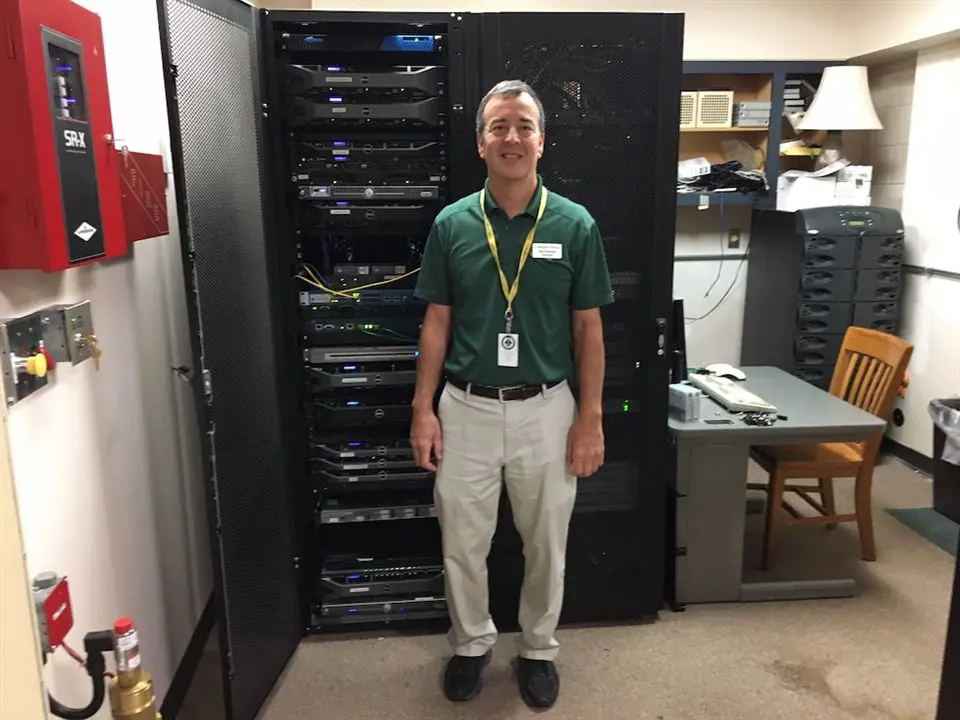
“This is what we call the Server Room,” he said as he stood before a large black case which houses several devices that to my untrained eye look like old DVD players. “It’s the Collegiate data center. The connection to our Internet service provider Comcast comes through here. Our connection to the phone system also comes through here.”
Around the corner were more devices linked with a plethora of various colored wires.
“Those are the core switches,” he noted. “That’s what connects all the campus buildings to the data center.”
Do you know what every wire, whether it’s yellow, orange, white, or blue, goes to? I asked.
“Pretty much,” he responded in an it’s-all-part-of-the-job manner. “If I don’t, I look it up. I’ve been here since most of the stuff was put in, so I was involved with configuring it and maintaining it. Over time, I’ve learned how everything’s connected.”
Anything else? I asked.
He pointed out a router which he explained connects the Robins Campus network and phone system to this room almost four miles away. He then explained a couple of worst-case-scenario precautions.
“There’s a fire suppression system,” he said. “There’re two air conditioning systems that run on natural gas generators so even if the power goes out, we have cooling and the servers are up and running.”
So how did Sherman come to learn the intricacies of technology? By accident, he says.
A Putnam, CT, native who grew up in the Maryland-DC area, he took an entry level position at a local Computer Land to make a few bucks when he was a student at University of Maryland.
The company transferred him to Richmond in 1987, and his interest and expertise eventually directed him to systems engineering. After a couple of job changes, he landed with Sycom Technologies, which assigned him to Collegiate as a contractor. Six years later, he came on board full time.
“(Working as a contractor) is a good place to get experience,” he said. “You have the opportunity to learn in that environment, but I was looking for the right place to work without the pressure to generate revenue and travel. Collegiate felt like the right fit.”
Lest you think Sherman spends every waking hour staring into a computer screen in his office located behind the Help Desk or ensconced in the Server Room, he actually has a very active and interesting life outside school.
He’s an avid pool player and a member of a team called the Felt Monkeys which competes in a local American Poolplayers Association league. In 2009, they finished 33rd out of 500 entries in the APA national championship event in Las Vegas.
“I always enjoyed pool, even from a young age,” he said. “Whenever there was a pool table, I was drawn to it.”
The home location for Sherman’s group is the Huddle Up Sports Bar & Grill in Ashland. Their game of choice is 9-ball.
“In league play, there’s a lot more strategy involved than playing recreationally,” he said. “One of the big differences is defensive shots. Normally, when you’re playing recreationally, you’re trying to make every ball. To be really good in league play, you have to learn defensive shots. If you don’t have a good chance of making a shot, you’re trying to play a defensive shot where you’re leaving your opponent a difficult shot.”
The Felt Monkeys are in the midst of their fall season. Their goal, as always, is to qualify for, then win, the local Vegas Cup championship and then head to pool’s “Big Dance.”
“We’re trying to win as a team,” he said, “but I really enjoy the camaraderie. We’d like to go to Vegas. But the idea is just to have fun.”
Sherman is also an ardent cyclist.
“Mainly road cycling,” he said, “but more recently mountain biking. I had friends who got into it. I was looking for some way to get additional exercise. Once I got started, I really enjoyed it. It got to the point where at least every Saturday, we went down and rode sections (usually 25 to 30 miles) of the Capital Trail.”
Sounds like a pretty full day, I said. Do you ever rest?
“I have a lot of interests outside the job,” he said. “I try to manage my time so I can participate in all the activities that I really enjoy.”