
safety first, safety always
OK, folks, let’s talk speed bumps.
Yep, those six bright-yellow, impossible-to-miss speed bumps strategically located in two groups of three on either side of the crosswalk down by the athletic complex on Collegiate’s North Mooreland Road campus.
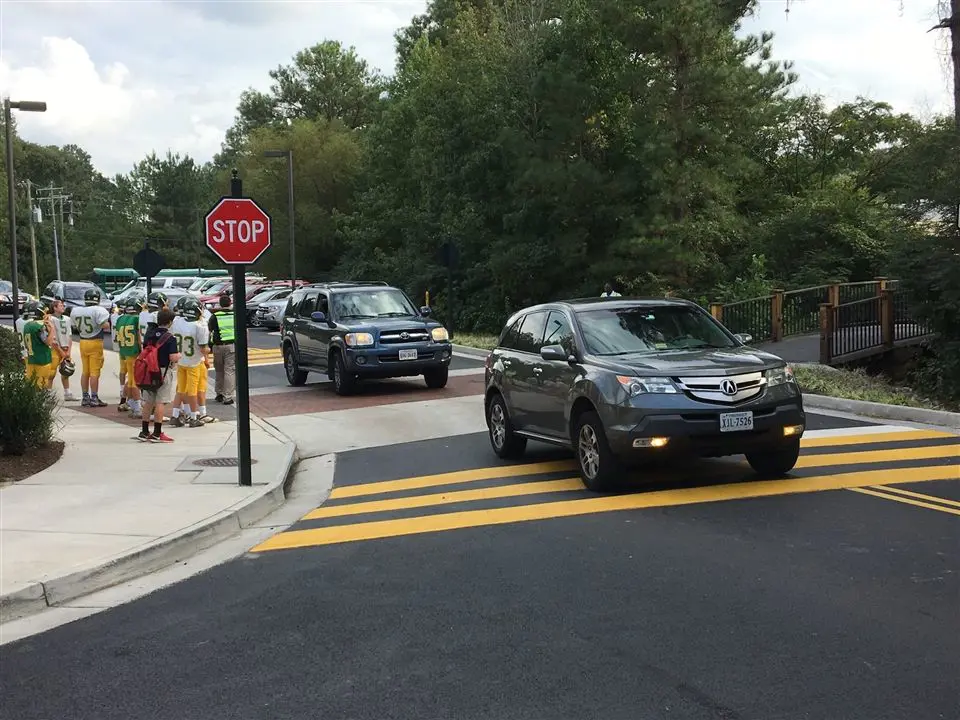
If you’ve driven over them since they were installed this past August, you know the feel. If you haven’t, well, let’s just say that they take some serious getting used to. Slow and steady, by the way, works as well as anything.
If this heavily traveled sliver of Collegiate real estate were a perfect world, we wouldn’t need even one speed bump, much less six. As we all know, however, there is no perfect world, especially when too many drivers are rushing, fiddling with their devices, and otherwise not paying100 percent attention.
To understand the rationale for these speed bumps, we have to know a bit of Collegiate history. Until six years ago, the area east of the pathway between the athletic center and the footbridge across the creek was basically a cul-du-sac with a handful of parking spots. In January 2011, the large 255-space East Lot opened for business, and Lansing Lane, the one-way loop road, became a major thoroughfare. Consequently, every vehicle entering campus from the north had to exit across the newly constructed, elevated, brick-and-concrete crosswalk that led to the athletic fields and Lower School.
The problem was that cars and trucks entering the gym area from North Mooreland could still cross the walkway as they headed to the parking lot creating two-way east-west traffic flow at the very spot where high-volume pedestrian travel was crossing north-south.
It was a mishap, or worse, waiting to happen, even with a campus-wide 10-miles-per-hour speed limit, and those of us who frequent that area saw far too many near misses.
To remedy the problem, temporary stop signs were installed on both sides.
“That helped,” said director of security Jason Stone, “but we still had people blowing through them even at the busiest times.”
Flashing lights were added, but to no avail. Then, permanent stop signs went up.
“Still didn’t work,” Stone said.
A year ago, representatives of Margolis Healy, a respected security/safety consulting firm, did a campus assessment. They asked Stone what kept him up at night.
“Easy,” he told them. “That crosswalk.”
So Stone escorted the Margolis Healy rep to take a look at the steady stream of vehicular and foot traffic.
“While we were standing at the intersection,” Stone recalled, “someone passed us at about 30 miles per hour, bottomed out (on the speed table), and almost hit us. It was a bigger car, a red car. When we saw it coming fast, we moved to get out of the way. I don’t even think they saw us. That was scary.”
Stone, by the way, is an ex-Marine. Not much scares him.
“Margolis Healy said we had to beef up the area,” he continued. “We had to physically stop vehicles so they would acknowledge the presence of that crosswalk.”
Now, if you’re involved in any way with morning drop-off or the afternoon departure, you know quite well that traffic flows more slowly than it did in the past. Sometimes the pace is glacial. Sometimes, there’s no pace at all, caused, more often than not, by the bottleneck created by the confluence of vehicles using Lansing Lane as it was designed and those leaving the East Lot.
Granted, traversing three speed bumps, then a speed table, then three more speed bumps, isn’t a summer day at the beach. Some have complained that the impediments are tough on their car’s suspension. Others have referred to the ride as a roller coaster. Still others have said they need Dramamine to quell that nasty seasick feeling as they bounce up and down, up and down, up and…well, you get the point.
But, friends, this is the real point. Like ‘em or not, the speed bumps are there for safety. Our kids’ safety. A minor inconvenience is a small price to pay, don’t you think?