life in the learning bridge fast lane
Her days roll past at NASCAR speed.
One minute, Cheryl Groce-Wright has the phone to her ear as she fields questions.
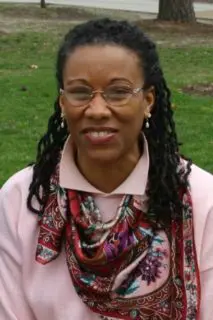
The next, she’s counseling a youngster who seeks her out for advice.
The next, she’s providing guidance for an aspiring teacher pulling his (or her) first extended duty before a classroom of energetic kids.
The next, she’s extinguishing a fire.
Ah, such is life for the director of Learning Bridge, a Collegiate-based summer program that provides academic enrichment for high-potential but disadvantaged City of Richmond middle school youngsters and a training ground for the teachers of tomorrow.
“I’m kind of the on-the-ground person who has to know everything,” she explained with a smile one recent afternoon during a brief pause in the action.
“I have to be everywhere at all times, which is challenging.
“I go home sometimes and tell my husband (Richard Wright) that 90 people needed to ask me something today, and they did.”
Then she laughs.
In fact, she laughs and smiles often, a sure-fire sign that she truly loves what she’s doing.
“Absolutely,” she said. “Some days, I drive to work and can’t believe how much fun I have.
“I work with great people. Not everybody can say that.”
A native of Binghamton, NY, Cheryl earned a B.A. in communications from SUNY Oswego and a M.Ed. in psychological services from the University of Pennsylvania.
After her graduations, she served each of her alma maters as an admissions officer whose focus was recruiting minority students.
Her professional endeavors gave her clarity of purpose, and in the ensuing years she became quite adept at working with at risk, generally disadvantaged, African-American young people.
“That’s my passion,” she said.
Cheryl has directed the Learning Bridge program for four summers.
“I came in with a real desire to provide a structured program for students who haven’t had that in school,” she explained. “If they get a taste of that, it carries them to a different place during the school year.
“The staff that already existed supported me in a way that we just did a bang-up job.”
The LB session lasts four weeks (plus an orientation week for first-year students). Faculty and staff make a seven-week commitment.
Cheryl’s job, though, is year-round except for a respite in August after the smoke finally clears.
By September, she’s busy fund-raising. Much of the $1,500 - $1,700 per-student cost comes from foundations. Individual donors provide the rest.
In January, she begins the recruiting process for students, instructors, and faculty mentors.
The backbone of the program, of course, is the teachers, mostly college kids (including Collegiate graduates Carmen Thornton, Emily Melson, and Ben Schewel) considering a career in education.
“I’m fortunate to get amazing teachers,” Cheryl said. “It’s important to have the right mix of students that want to work hard during the summer. These do.”
Curriculum planning – classes, field trips, projects, and themes – begins in April under Cheryl’s direction and continues full-bore until classes begin in late June.
Once on campus, the 83 youngsters guided by 30 teachers and administrators take core classes with a dose of values education thrown in.
“We provide a loving, nurturing structure that every Middle School kid needs,” Cheryl explained. “You pair that with the opportunity to explore new things, jump into new ways of learning, and interacting with other people.
“That balance makes kids soar.”
As in any educational setting, the adult leaders, Cheryl included, profit from the LB experience just as their young charges do.
“We teach life lessons,” she said. “For the kids that this program makes a difference for, it makes a huge difference.
“It means the world to know that there’re folks out there that I may never see again, but there’s something I did that was meaningful, that propelled them forward, that helped them learn a lesson and set them on their path.
“That’s why I do this. That’s why Learning Bridge is worth it to me.”