
gordon fogg '82: distinguished alumni award recipient
A few short weeks after his graduation from Collegiate in 1982, Gordon Fogg left the safety and security of his parents’ home on Westham Parkway and ventured into a world more intense, harrowing, and adrenalin-charged than he could ever imagine.
Four years later, he graduated from the U.S. Naval Academy with a degree in systems engineering, a program with a 50 percent attrition rate, then embarked on extensive flight training and earned his wings in 1988.
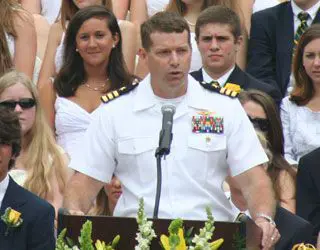
His baptism of fire came quickly. During the First Gulf War, he found himself in the cockpit of an F-14 Tomcat, flying mission after mission across Iraq from the deck of the U.S.S. Saratoga based in the Red Sea.
“The environment was inherently unsafe, stressful from beginning to end,” said Fogg, whose code name is Dart. “You learn to deal with the fear. It’s an emotion so strong that it can paralyze you. Once you become used to it, it becomes anxiety which you can cope with.
“Experience allows you to manage it. You let your training kick in. You compartmentalize. You focus on the task at hand.”
Now a commander stationed at the Pentagon where he serves on the staff of the Chief of Naval Operations as Joint Strike Fighter Requirements Officer, Fogg went on to log 3,700 hours in the air, make 850 carrier-arrested landings, and earn a host of medals and commendations.
This morning, he was back at Collegiate’s commencement to receive his alma mater’s Distinguished Alumni Award, clearly thrilled to share the moment with 127 seniors, their families, and friends.
“I’m honored and humbled, especially in light of the level of graduates Collegiate produces,” he said. “I consider this honor to be representative of the greater service our American men and women are doing every day.”
In addition to his initial deployment during Operation Desert Shield and Operation Desert Storm, Fogg lists three other noteworthy assignments during his 22-year career, which will conclude with his September 1 retirement.
The second came when he served three years (1992-1995) as an adversary pilot at NAS Oceana in Virginia Beach.
“We were trying to duplicate the tactics of the Soviets,” he explained. “We were almost like a scout team.
“What made it fun was that we flew three different kinds of airplanes (F-16, F-5, and A-4) and trained the fleet squadrons to prepare for the next conflict.”
His third was much less risky but challenging, fulfilling, and invigorating nonetheless.
From 2000-2002, he was stationed at the Supreme Headquarters Allied Powers Europe in Casteau, Belgium, where he worked with a multinational team writing policy papers for the transformation of NATO from a Cold War posture to a flexible, deployable force.
“It was a fantastic family experience,” he said. “Professionally, it was also a great experience. It gave me an understanding of how officers from other countries view the world. It’s very gratifying to see that many of the policies we crafted have come to fruition.”
In 2003, Fogg reported to NAS Lemoore in California as executive officer of a squadron dubbed the Blue Diamonds.
Thus began his fourth career highlight.
In May 2004, he assumed command of the struggling unit (250 men and women and 12 aircraft) and over the next 16 months helped give it direction and develop a culture of excellence.
“We flawlessly executed an around-the-world deployment which included supporting combat operations in Iraq for over four months,” he said.
“To watch a group of extremely talented people rise to their potential was extremely satisfying.”
While Fogg has gained a wealth of experience since his days on North Mooreland Road, he looks back on his time spent in the classrooms and on the playing fields of Collegiate as a rock-solid foundation.
“The beauty of Collegiate is that it wasn’t just about what you learn,” he said. “Collegiate gave me the ability to think through complex problems one step at a time, to break them into manageable parts when the totality might seem overwhelming.
“It gave me the opportunity to be part of a team and develop leadership skills.
“I’ve always been Type A, and Collegiate allowed me to be myself and harnessed my ability without stifling creativity and aggressiveness.
“It allowed me to make mistakes and learn life lessons from them.
“Collegiate was definitely a very positive experience.”