
Expansive Perspectives
As part of a professional development experience, Collegiate teachers Teresa Coleman and Monica Melton traveled to Ghana to enhance their own teaching technique.
Back in May, Middle School art teacher Teresa Coleman was in the Ashanti region, in Ghana, sitting at a loom roughly 100 years old, learning the craft of kente cloth weaving from a master of the trade. It’s a technique borne out of various traditions, some of which existed before the formation of the Ashanti region itself, and through the diligence of countless apprenticeships has been passed down for centuries, through networks as complex as the patterns woven in silk, making its way to Coleman.
The deeply rooted tradition of Kente cloth weaving found its way to Coleman through the support of Collegiate’s professional development programs. Made possible by philanthropic support, a number of faculty members embark on projects each year that focus on enhancing the School’s educational experience through a variety of professional development offerings. In partnership with Director of Global Engagement Monica Melton, Coleman traveled to Ghana to connect with the Ghana International School (GIS), a Collegiate partner school, and explore artistic practices in cities around Ghana.
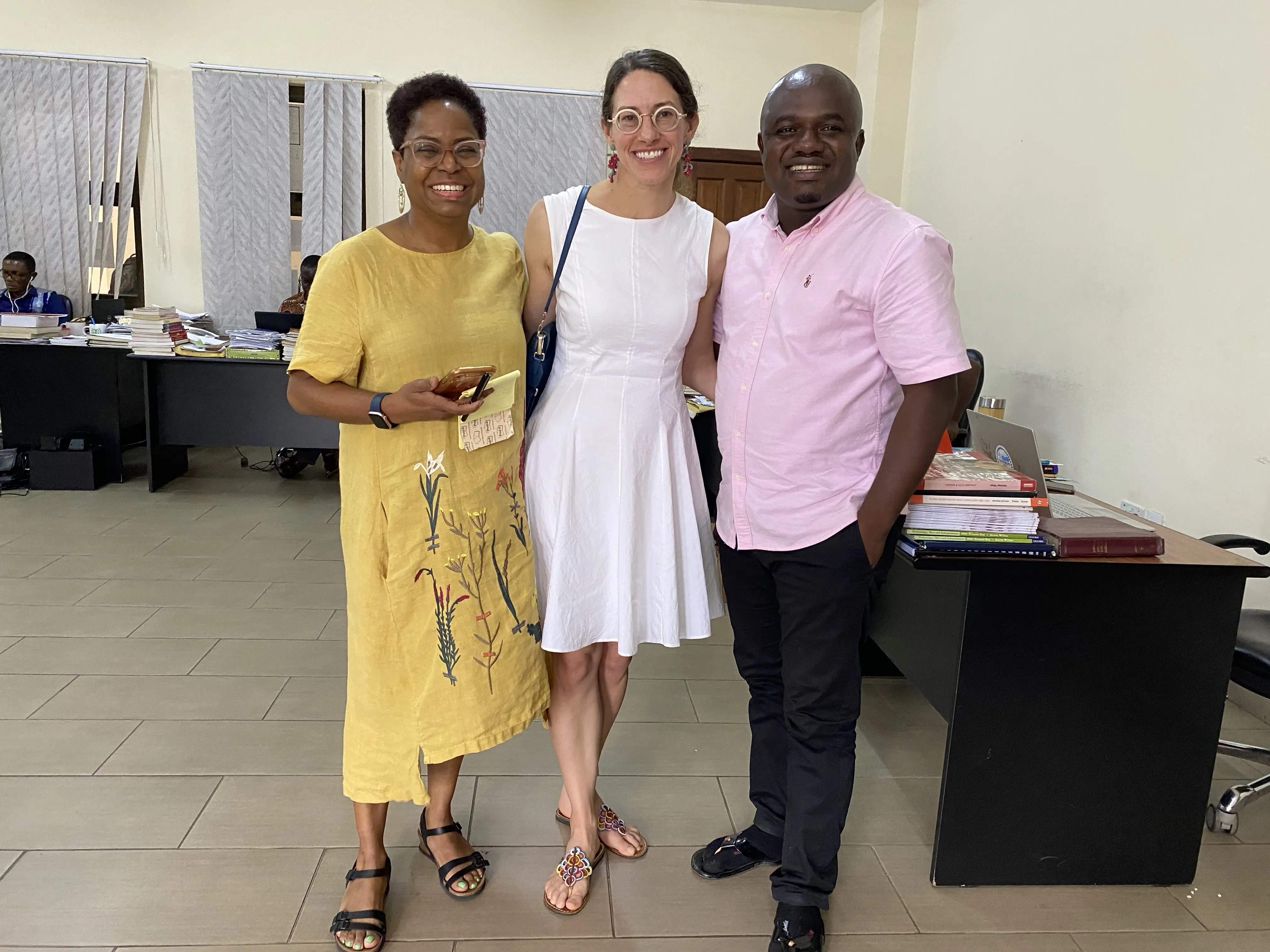
Collegiate teachers make discoveries in ways similar to Collegiate students — through experiential learning. In addition to hosting Collegiate teachers abroad, GIS travels to Collegiate’s campus annually for the International Emerging Leaders Conference, creating a reciprocal relationship of expansion for both schools and their educators. It’s an experience that removes the boundaries of campuses and countries to focus on the future of education. “It’s so powerful to be brought into another community in this way,” Melton says about the partnership with GIS. “At the end of the day, we have the same goals for what skills we want our students to have. Each one of us is focused on how we can best support our students to develop self advocacy, civil dialog, and other necessary skills that are important for any student to be healthy and successful.
Observing the overlaps of how a teacher in Ghana might approach a certain subject is invigorating, but noting the nuanced differences can prove to be equally fruitful. Sometimes, learning something new requires you to step outside of your conditioned environment. “Opportunities to connect with other teachers increases perspective and ultimately creates empathy,” Melton says. “The realization that you’re connecting across differences creates curiosity and new possibilities for how to approach a classroom.
Life is about discovering more of yourself in the process of living. It’s experiencing new moments, meeting new people, learning new ideas. This is what opportunities like this one are founded on. These experiences foster true growth through deeply immersive learning. “I feel that this trip expanded me,” Coleman says. “The practice of learning to appreciate other people and learning from them and their lives helps you appreciate your own experience and puts it into context.”
The deeply rooted tradition of Kente cloth weaving found its way to coleman trhough the support of collegiate's professional development programs.
It is both an astonishing and sensible fact that students are introduced to coding practices as young as their JK year at Collegiate. Yet, similar to learning a language, complex concepts are more comprehensible when learned at a young age, especially when introduced in an easily digestible, age-appropriate way. In JK, for example, students learn the concept of logical sequencing — if this happens, then this happens — without looking at a computer, but the practice follows the same principles as code. “Basic coding is sequencing and putting together tools like color blocks,” Gregory explains. “It’s a sequence of steps that conditions students to think in a certain way. It’s repeating patterns in a loop to create some kind of reaction.”
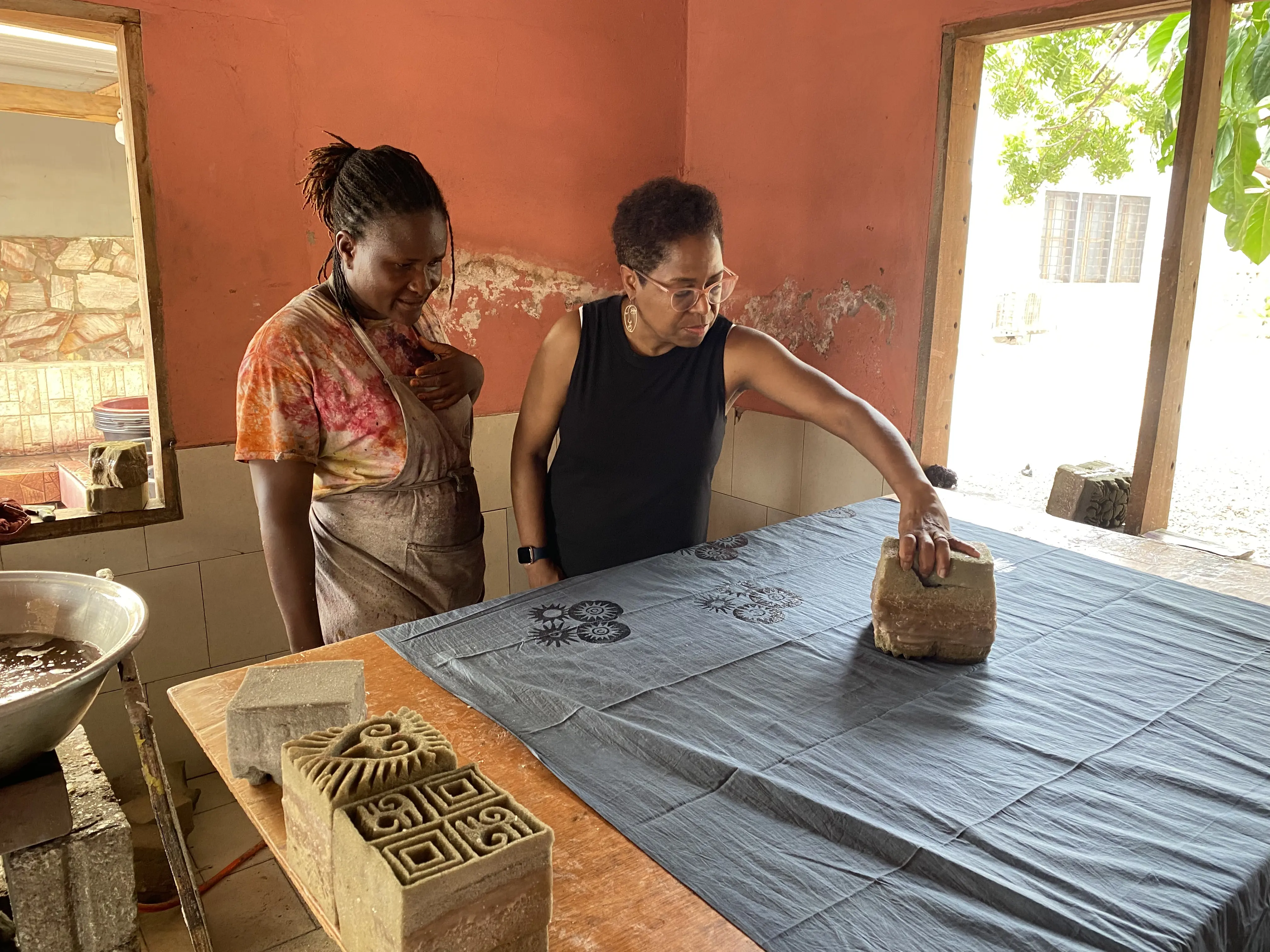
In Coleman’s own classroom at Collegiate, students practice techniques of printmaking. Traveling to Accra, Ghana, to observe how a fabric dyeing technique called batik is practiced, expands what is possible to bring to a classroom art setting. “To see workshops such as the ones in Accra takes the action and the activity and even the product out of the realm of theory and into the realm of reality,” Coleman says. “Once you can have the real experience of doing something, of seeing it put into practice, makes the connection deeper and makes for a more immersive experience.”
These professional development opportunities, in turn, enhance students’ education; the techniques Coleman has learned can be applied in the classrooms at Collegiate.
Perspective — that particular elucidating insight that brings us all closer together — is an important aspect of growth. No matter the age, we all need to learn and grow. Collegiate recognizes that, and this kind of professional development helps fulfill a yearning for learning. When teachers grow, so do students. “I’m always trying to figure out how I can teach a lesson better, and working with other teachers is such an important part of that learning,” Coleman says. “In our work we aim to show students their world outside of a prescribed path that they might not have considered,” Coleman says. “Experiences like these help me do that. It has connected me with another part of the world — one that I can hopefully bring back to students.
The practice of learning to appreciate other people and learning from them and their lives helps you appreciate your own experience and puts it into context.
Teresa Coleman
Middke School Art Teacher