a visit with susan campbell bartoletti
She planned to be an artist.
Though she readily acknowledges that she was no Picasso, she showed great promise, received some measure of local acclaim, even won some prize money for paintings she displayed at shows around her hometown, Moscow, near Scranton in northeast Pennsylvania.
One day in college, though, Susan Campbell Bartoletti, by then an art major, experienced a eureka moment.
“We were sitting around with our work on easels,” she recalled.
“While I was getting A’s, inside I didn’t think my work was as good (as other students’).
“I thought, if I’m not going to be an artist, what am I going to be?
“At the same time, my English teachers were praising my writing. .
“As one door was closing, a window was opening.”
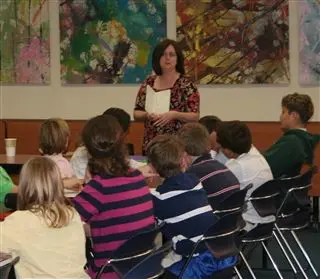
Such was the beginning of her career as an award-winning author, but Bartoletti, who spent two days at Collegiate this week discussing her trade and conducting workshops for Middle School students, is much more than just a writer.
She’s the wife of a high school history teacher, mother of two adult children, and, as of six months ago, the proud grandmother of twins.
She’s a scholar with degrees in English from Marywood University (undergraduate), University of Scranton (master’s), and the State University of New York at Binghamton (PhD).
She’s a teacher, even though her 18-year career (8th grade English) ended more than a decade ago when she made the difficult decision to devote her professional time to writing.
Bartoletti’s 14 books (and three more on the way) address difficult, emotionally-charged topics, among them child labor, Nazi Germany and the Holocaust, the plight of coal miners, and the Ku Klux Klan.
They are meticulously researched, highly readable, moving, inspiring, and definitely thought-provoking.
During a break between sessions, we sat down to discuss informally her background, motivation, and insights about the writing process.
So how’s your time at Collegiate been?
Oh, wonderful. The kids have been so well prepared, and I’m impressed with the level of energy they’ve put into their writing workshop. I’m impressed with their poems and their willingness to share their words. Collegiate is such a wonderful opportunity.
What kind of questions have kids asked you?
They want to know about my own journey as a writer, how it all began, who or what inspired me to become a writer. They’re interested in the daily life of a writer, my work space, how I get my ideas, the actual research. Sometimes, students ask the questions that the answers are found in the book. I usually don’t give those kind of answers out. . If they’ll find out the answer by reading, that’s really what I want them to do.
Where do your ideas come from?
Every day, stories are all around us. You want to identify those stories, those ideas, that make your heart turn over, make your heart swell.
How does one decide to become a writer?
There’s a difference between deciding to be a writer and deciding to be a published writer. We’re all writers. I write every single day, 365 days a year, even if it’s only 15 minutes. I write a lot of things that will never see ink in a published book.
The path to becoming a published writer is, one, make the time to do it. Two is finishing what you start. It’s common sense stuff…finding the time to do it, feeding the passion, and finishing.
Is there a particular time of day you set aside to write?
I work mornings. When I was teaching full time, I had a stricter schedule. I would write from 4 until 7 every day. On the weekends it would be longer.
Do you mean 4 a.m. until 7 a.m.?
Yeah.
Yikes!
At 7, I would get ready for school. My children were younger, they were involved in activities, and I didn’t want to miss any of those activities. Now, I still get up very early. . I write usually until my husband comes home from work. Sometimes when I’m on deadline, I put in three shifts: morning, afternoon, and evening.
Do you have a particular place you write, or can you do your thing pretty much anywhere?
I’m a creature of habit. Even though I will work when I’m on the road, I have an office in my house. I also have a little outdoor writing studio that I call a snuggery.
Do you have a certain number of pages you try to write per day?
No. I think that’s a really good idea, and I keep telling myself I’m going to do it. But I know when it’s time to start, and I know when it’s time to quit.
What keeps you going as a writer?
Chocolate.
Chocolate?
Seriously, it’s not the finished book. It’s the hunt for stories. It’s the quest to make meaning out of history and human nature. It’s the desire to understand.
How important is it for a writer also to be a reader?
I tell young people that only a reader can become a writer. Let’s put it this way. There’re some kids in school today who might not consider themselves readers…yet. I don’t think it matters when that passion begins, but I do think you need to fill up that story well.
Should aspiring writers emulate others or develop their own style?
You often find that you emulate. . It’s part of the learning process, I believe. But a true writer discovers her own style at some point.
How important is the grunt work: proofreading, editing, and revising?
To me, the first question is when? Not everything that’s written needs to be taken to the final draft form…only those things which are going on to be what I call classroom published, handed in for a grade.
To me, editing is the best gift a writer can give herself, learning how to line edit. And, of course, proofreading, there’s no excuse now that we have computers checking everything, but you’d be surprised at how many kids forget to run the spell check.
Can writing truly be taught?
That passion has to be caught. I loved teaching. I loved teaching the research paper and essay writing. It all starts with passion. It’s a subject, and it’s a passion. .
What part of writing gives you the most joy?
Revising. I don’t like the first draft stage. It’s always the hardest stage for me. I love to revise.
You’ve written books about the Nazis, about the Klan, about man’s inhumanity to man.
Those are the subjects that I feel drawn to tell about. I have a very strong sense of justice. I like looking for stories especially of young people who’ve made contributions to history in ways that have made a difference for good.
Stories connect us. Stories teach us. They warn us never to forget. . One of the main reasons I do this is that I don’t want these stories forgotten. History will repeat itself.
Do you have a favorite literary creation?
No, no. Once a book is published, I don’t think it belongs to me anymore. . It belongs to the reader. It’s up to the world to either embrace it or not. . So I don’t have favorite books. . I do have favorite people I’ve met along the way. . Some are fictional people. . Some are historical figures. Some are still alive today, people I’ve interviewed.
You earn your living as an author, but is writing your job or your passion?
My passion. . If anyone goes into this because it’s a job, they need their head examined. You can tell those writers for whom it’s a job. For me, it’s a passion.