

a visit with hudson taylor
For Hudson Taylor, life is all about wrestling, respect, and enlightenment.
In fact, he sees a beautiful mosaic in which the three are intertwined and interrelated.
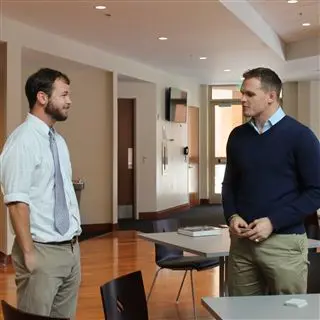
A 2010 University of Maryland graduate, Taylor was a three-time All-American wrestler. He now coaches his sport of choice at Columbia University in New York City, where he lives with his wife Lia Parifox.
For years, he experienced a macho, locker-room culture of trash talk and homophobic slurs and simply dealt with it although deep down he felt uneasy.
Finally, as a college senior, he decided to act.
He became an upstander rather than a bystander.
He began speaking out about prejudice.
He wore an LGBT rights sticker on his headgear.
Then, in the aftermath of his college athletic career, he founded Athlete Ally, a non-profit whose mission is “to encourage athletes, coaches, parents, fans, and other members of the sports community to respect all individuals, regardless of perceived or actual sexual orientation or gender identity or expression.”
It was in his role as executive director that he spent today at Collegiate, advocating for inclusion in Middle and Upper School assemblies and in small-group discussions.
“Everybody wants to conform,” he said. “Sometimes, the easiest way to fit in is to say nothing and do nothing.
“What I believe in is people being treated fairly.”
He challenged our students to make an impact and cited four ways to do so.
“Use your ‘virtual voice’” to post links, quotations, or personal statements advancing the cause of inclusivity.
“Wear your beliefs on your sleeve” by advocating for equality and respect.
“Fix the broken window,” a metaphor for ending derogatory comments, whether intended or unwitting.
Be the generation that ends prejudice and stereotypes.
Following one of his presentations, he fielded questions about his mission.
Why was it important for you to take on the cause of fostering inclusivity?
Sports is the most important thing in my life. The idea that there’s a group of people that are excluded from having that same experience really upsets me and continues to be a motivating force behind my work with Athlete Ally.
For me, it’s about a love of sports and providing equal access and opportunity to everyone through sports.
Was there one incident, a Eureka moment, that caused you to say, ‘Enough is enough’?
There was no light-switch moment. More than anything, it was a slow and gradual process of becoming confident in myself and my own beliefs and gaining some objectivity of the locker room culture.
Sometimes, it can be difficult to separate yourself from how your friends or teammates are acting. You don’t see the forest through the trees.
Because of the education I was receiving and the diversity I had in my own life, it made me aware of something I thought was very problematic.
Truthfully, I started out caring more about sexist language than homophobic language. The more I started to meet people who were very affected by this language and the culture in a terrible, negative way, it added fuel to my passion and made me continue to do everything I could to change the culture of sports.
Once you began to speak out, were there repercussions?
Certainly. That probably was the biggest fear for me, people saying, “Hudson, why do you care so much? Are you gay?”
I got to a place where I was comfortable with who I was. That was the point. What if I was gay? Was that a bad thing? Did that affect my ability to compete or be a leader or do my job as a wrestler?
I’m going to stand up and do the right thing regardless of how people see me or react to what I do.
What can our students learn from your message?
To be explicit in how they feel about these issues. I go to places, and, more often than not, people say, “You know what. I agree with you. We should be more respectful and more conscious of our words.”
It doesn’t always translate into action. For me, it’s like, how can we more explicitly cultivate a culture of inclusion?
Unless you say it explicitly, unless you wear that (OK2BU) wristband and talk about these issues on a daily basis, no one will know where you stand.
In the best of all possible worlds, what do you see?
(Professional basketball player) Jason Collins isn’t known as a gay athlete. He’s known as an athlete.
We get to a place and a time where coming out isn’t a front-page story and doesn’t make national news and where homophobic language is seen as unacceptable as racist language.
That’s the end result.